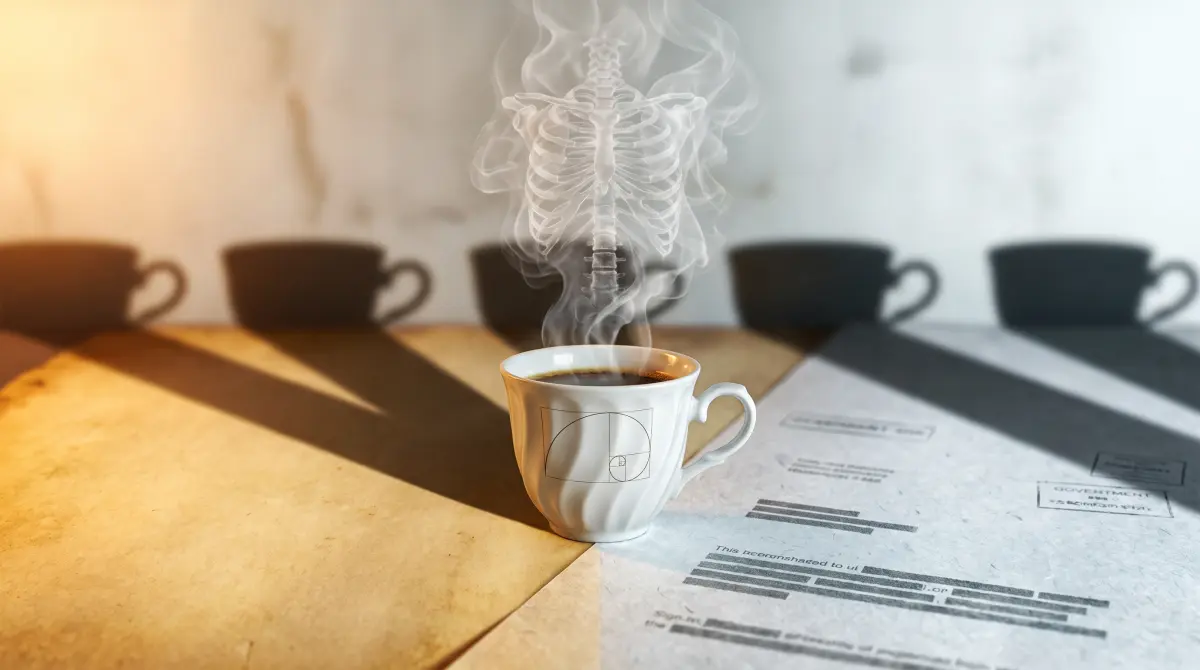
Five Cups: Who Profits When the Government Tells You to Drink More?
The American Heart Association just gave America a second coffee. The industry is celebrating. Your bones are not. And somewhere in Silicon Valley, a VC is already building a Five-Cup Subscription Box.
Every generation has that family member who texts you at 8am with a hot investment tip. The tip is always something the news said was good for you. Coffee. Red wine. Eggs. Bitcoin. Whatever just got a government green light that morning. The logic is airtight: government says it's healthy, people will buy more, buy the machine, buy the stock, get in early.
They are not wrong that there is money in it. They are just asking the wrong question. And so is the government.
This morning the American Heart Association published a landmark statement in the journal Circulation. The headline: up to five cups of coffee per day is safe for most adults, potentially linked to lower risk of heart failure, stroke, and type 2 diabetes. America grabbed its fourth cup and exhaled. The National Coffee Association's CEO declared that coffee drinkers "live longer, healthier, happier lives." The stock tickers twitched. The Keurig pods flew off shelves.
Let's talk about what they buried in paragraph nine.
◆ What the Fine Print Actually Says
The real sweet spot the AHA identified is two to four cups ✦ not five. Five appears "safe," which is a clinical way of saying it probably won't kill you on a Tuesday. Benefits plateau or reverse beyond four cups, and side effects ⋯ disrupted sleep, elevated anxiety, blood pressure spikes ⋯ become more likely.
More critically: these heart-healthy findings apply strictly to paper-filtered or instant coffee. Not espresso. Not French press. Not Turkish. Those methods retain a compound called cafestol that actively raises LDL cholesterol ✦ the kind that quietly clogs arteries while you congratulate yourself for drinking "heart-healthy" coffee.
So the government said five cups is fine, as long as it's filtered, without sugar, without cream, without syrups, and you have no existing heart condition, no genetic caffeine sensitivity, are not pregnant, are not a teenager, and are not taking certain medications. Other than that: drink up, America.
The report also, quietly, says nothing about what coffee does to the rest of your body ⟶ specifically your skeleton.
◆ Your Heart Might Survive It. Your Bones Are a Different Story.
For every 150mg of caffeine consumed, research shows the body may lose approximately 4 to 5mg of calcium through increased urinary excretion and reduced intestinal absorption. That loss compounds daily over months and years. Studies have found that postmenopausal women who consume more than 300mg of caffeine daily ✦ about three cups ✦ show significantly lower bone mineral density in their spine and hip regions.
Human studies suggest caffeine may also interfere with the activity of vitamin D receptors and bone-forming enzymes in osteoblasts. Less vitamin D receptor activity means less calcium absorbed from everything you eat. The AHA was measuring hearts. Nobody measured bones.
"Safe" is not the same as optimal. A permission slip issued to an industry, laundered through science, and delivered to consumers as health news ⟶ is still a permission slip.
◆ Who Actually Wins When the Ceiling Goes Up
Let's follow the money. 66% of Americans had a coffee in the past day ✦ that's roughly 220 million cups. The US coffee market is worth over $100 billion annually. When the government raises the daily ceiling from four to five cups, that is not a health recommendation. That is a market expansion event.
The food and beverage industry has given close to $200 million to Political Action Committees and Congressional members over recent three-year cycles. Industry funds studies, cultivates nutritionists, and shapes the language that becomes policy. The AHA's own funding streams include industry partnerships. This is not conspiracy ⟶ it is the ordinary mechanics of how guidelines get made in America.
When five cups gets the green light, Starbucks (https://www.starbucks.com) sells more Venti drip. Nestlé moves more pods. Keurig machines fly. The farmer in Ethiopia who grew the bean still earns under $2 a day. GDP goes up. Bone density, calcium absorption, and meaningful farmer equity go sideways. The machine is a great buy for the company that makes it. Less so for the body that runs on it.
◆ What You Should Actually Drink in the Morning
If the goal is a morning ritual that upgrades your cognition, protects your body, supports mineral absorption, and doesn't require a five-paragraph government disclaimer ⟶ here are the alternatives that actually hold up.
Ceremonial Matcha (https://teaperfectionist.com/best-matcha-tea/) · L-theanine plus roughly 70mg caffeine creates sustained alertness without the jitter spike. 137x more antioxidants than brewed green tea. Protects rather than depletes calcium. The Japanese have been right about this for 800 years. Get authentic Uji origin ✦ anything from China at under $10 is powdered nostalgia. About $1.50 per serving. Value: Exceptional.
Lion's Mane + Cordyceps (https://us.dirteaworld.com) · Lion's Mane stimulates nerve growth factor ✦ actual brain tissue repair, not marketing copy. Cordyceps boosts mitochondrial oxygen efficiency. Together they deliver focused energy that compounds long-term rather than burning adrenal credit you'll pay back by 3pm. About $40 to $65 per month. Value: Strong.
Cacao + Reishi (https://mudwtr.com) · Raw cacao carries theobromine ✦ a gentler, longer-lasting stimulant than caffeine with zero calcium disruption. Reishi is the stress modulator: it doesn't rev you up, it stabilizes the baseline so you can actually think. This is what a morning ritual feels like when it's designed for humans, not productivity theater. About $30 to $50 per month. Value: Good.
Yerba Mate (https://www.guayaki.com) · About 80mg caffeine, plus theobromine and theophylline ✦ a more balanced stimulant triplex than coffee alone. Used by entire South American civilizations as a social ritual rather than a solo productivity hack. Richer in antioxidants than green tea. About $12 to $20 per 250g loose leaf. Value: Outstanding.
If you must drink coffee ✦ and some of you will, because you are human and ritual matters ✦ drink less, drink better, and drink filtered.
◆ The Coffees Worth the Conversation
Running BrewSoul (https://tonygreenberg.com/brewsoul) ✦ a scored database of 107 specialty coffees evaluated on cupping quality, mold testing, farmer transparency, and actual value ✦ the coffees that score highest are not the ones with FDA-blessed volume guidance or the biggest marketing budgets. They are the ones with radical process accountability and stories that justify the price.
BrewSoul Spotlight · Wow Score 98/100: Finca Deborah Aurora Panama · Boquete · Anaerobic Natural · Gesha
Anaerobic fermentation means the cherries are sealed into oxygen-free tanks ✦ temperature monitors, pH meters, 48 to 96 hours of controlled microbial activity where different organisms take over and produce flavor compounds that standard processing simply cannot reach. One wrong variable and competition-grade coffee becomes compost. Finca Deborah does not make mistakes.
The result tastes like tropical fruit, champagne, rose water, mango, and vanilla arrived in a cup and decided to stay. This is what coffee is when the craft matches the biology.
Cupping Score: 93/100 · Mold Tested: Verified · Farmer Grade: A · Price: $120/150g · Wow: 98/100
See all 107 coffees scored in BrewSoul ⟶ https://tonygreenberg.com/brewsoul
◆ The Bigger Pattern ✦ and Where This Goes
We are living through a moment when the old infrastructure of health guidance ✦ government agencies, professional associations, industry-funded research ✦ is losing credibility faster than it can publish corrections. People feel it. They know the Dietary Guidelines are negotiated documents. They know "safe" is a liability term, not a wellness prescription. They are done outsourcing their biology to institutions with conflicts of interest.
What comes next is not cynicism ⟶ it is precision. The next generation of morning rituals will be built on biomarker feedback, on understanding your specific CYP1A2 gene variant that determines how fast you metabolize caffeine, on sourcing transparency that tells you who grew the thing and what they were paid. The question shifts from "how many cups is the government okay with" to "what does my body actually respond to, and does the supply chain behind it reflect the values I claim to hold."
That is not a utopian fantasy. That is already being built. And the brands, practices, and assets that reflect that future will dramatically outperform the ones still riding government-endorsed volume guidance into a saturated commodity market.
My father's instinct was not wrong. He just asked the right question at the wrong resolution. The money is not in the machine. The money is in the movement away from the machine toward something that knows what it is, where it comes from, and what it is actually trying to do to the human who consumes it.
Five cups is a headline. Consciousness is a strategy.
⁂
✦ GemSpark of the Day Aspen, Colorado. Felix Coffee.
She handed me the cup with both hands. Not the way you hand someone a coffee. The way you hand someone something that matters.
She was from Kenya. So were the beans. She had grown up near the farm where these were harvested. She knew the altitude. She knew the rain patterns that year. She knew the hands that picked them. And now here she was, at a counter in one of the most expensive zip codes on earth, watching a stranger take the first sip of something she had carried across a lifetime.
We did not exchange cards. We did not connect on anything. What passed between us was older than that. A recognition. The kind that does not require language and does not survive translation. The kind you feel in your chest before your mind has a word for it.
And then I thought of Will Poole ✦ an emerging-markets investor who has backed dozens of entrepreneurs in Kenya, who was somewhere in this same town that morning. I wanted to introduce them. I still do. That is the only place on earth where that introduction is even possible ✦ a Kenyan woman behind a coffee counter in Aspen, and the man who has spent his career investing in the country she came from, both within walking distance of each other on a Tuesday.
That is a GemSpark. That is exactly what it is.
Coffee is the only thing on earth that can do this. Not LinkedIn. Not Davos. Not a conference room with a view. A cup. A counter. Two people on opposite ends of a supply chain, briefly occupying the same moment as equals.
The distance between the person who grows it and the person who drinks it is where most of the value gets extracted and most of the meaning gets lost. BrewSoul (https://brewsoul.com) is trying to close that gap.
⁂
Further Reading
These are the threads worth pulling after this one:
The Psychedelics Could Become Extractive Capitalism (/blog/psychedelics-could-become-extractive-capitalism) · Written for DoubleBlind in 2021. The same pattern: an industry captures a wellness movement, launders it through science, and sells volume. The warning was already there.
ImpactSoul (https://impactsoul.is) · The thesis behind this essay made investable. Regenerative vs. extractive. Transparent vs. opaque.
BrewSoul Coffee Intelligence (https://tonygreenberg.com/brewsoul) · 107 specialty coffees scored on cupping quality, mold testing, farmer transparency, and actual value. The antidote to government-endorsed volume guidance.
Outlive by Peter Attia (https://www.amazon.com/Outlive-Longevity-Peter-Attia-MD/dp/0593236599) · The science of longevity without the biohacking vanity. Chapter on caffeine metabolism and CYP1A2 genetics is essential reading.
Count Down by Shanna Swan (https://www.amazon.com/Count-Down-Threatening-Reproductive-Development/dp/1982113669) · The definitive book on how chemicals are reshaping human biology. Same pattern, different compound.
The Omnivore's Dilemma by Michael Pollan (https://www.amazon.com/Omnivores-Dilemma-Natural-History-Meals/dp/0143038583) · The original follow-the-money investigation into how industrial food systems captured government nutrition guidance.
⁂
Five Questions Worth Sitting With
These are not rhetorical. Leave your answer in the comments ✦ the most interesting responses will be featured in the next BrewSoul dispatch.
What does your morning ritual actually optimize for, and who designed it? Most morning routines were assembled from marketing, not intention. Trace yours back. Who told you five cups was the goal? What were they selling?
If your CYP1A2 gene variant meant you metabolized caffeine slowly, would you change anything? Slow metabolizers face significantly elevated cardiovascular risk from high caffeine intake. The test costs $99. Most people have never taken it. Why not?
What is the last thing you consumed where you knew exactly who grew it, what they were paid, and how it was processed? Not the brand story. The actual supply chain. If you can't name one thing, what does that tell you about the system you're participating in?
At what point does "safe" become a good enough standard for what you put in your body every single morning? Safe is a floor, not a ceiling. What would optimal look like, and what would it cost you to find out?
If the government raised the daily recommended limit on something you currently avoid, would you reconsider it? This is the real question. Because that's exactly what happened with coffee ✦ and most people updated their behavior without asking who updated the guideline.
⁂
Tony Greenberg is Founder & CEO of RampRate (https://ramprate.com), Founder of ImpactSoul (https://impactsoul.is), author of boy in the human (https://tonygreenberg.com), and creator of BrewSoul Coffee Intelligence (https://tonygreenberg.com/brewsoul). He spoke on the same stage as Ray Kurzweil in 2010 and has spent 25 years benchmarking what institutions say versus what the data shows.