
HUMAN OS V2.0

The machine is perfect. BE THE GLITCH.

Reclaim agency in the age of algorithmic control.

Are You a Maximizer or a Satisficer?

We are being optimized to death. Every app, every feed, every notification is designed to make you believe that the next click, the next purchase, the next upgrade will finally make you complete. It won't. It can't. That's the trap.

Human OS 2.0 is the counter-protocol. A system for the Conscious Satisficer — someone who has learned to define their own criteria for "enough" and stop when they get there. Not settling. Choosing.
What You'll Discover

Take the Diagnostic

"Are you playing the game, or is the game playing you?"

8 questions. 3 minutes. Discover your path to conscious agency.

Begin Diagnostic →

Explore the System

The Philosophy: Boiling the Human, the Maximizer Trap, and the Conscious Satisficer framework.

The Ecosystem: Mentors, advisors, partners, and the companies that shaped this thinking.

Resources: Transformation playbooks, daily practices, and the essential reading list.

Path to Here: From the 2010 H+ Summit to today — the architect's journey.

The Core Framework: Maximizer vs Satisficer

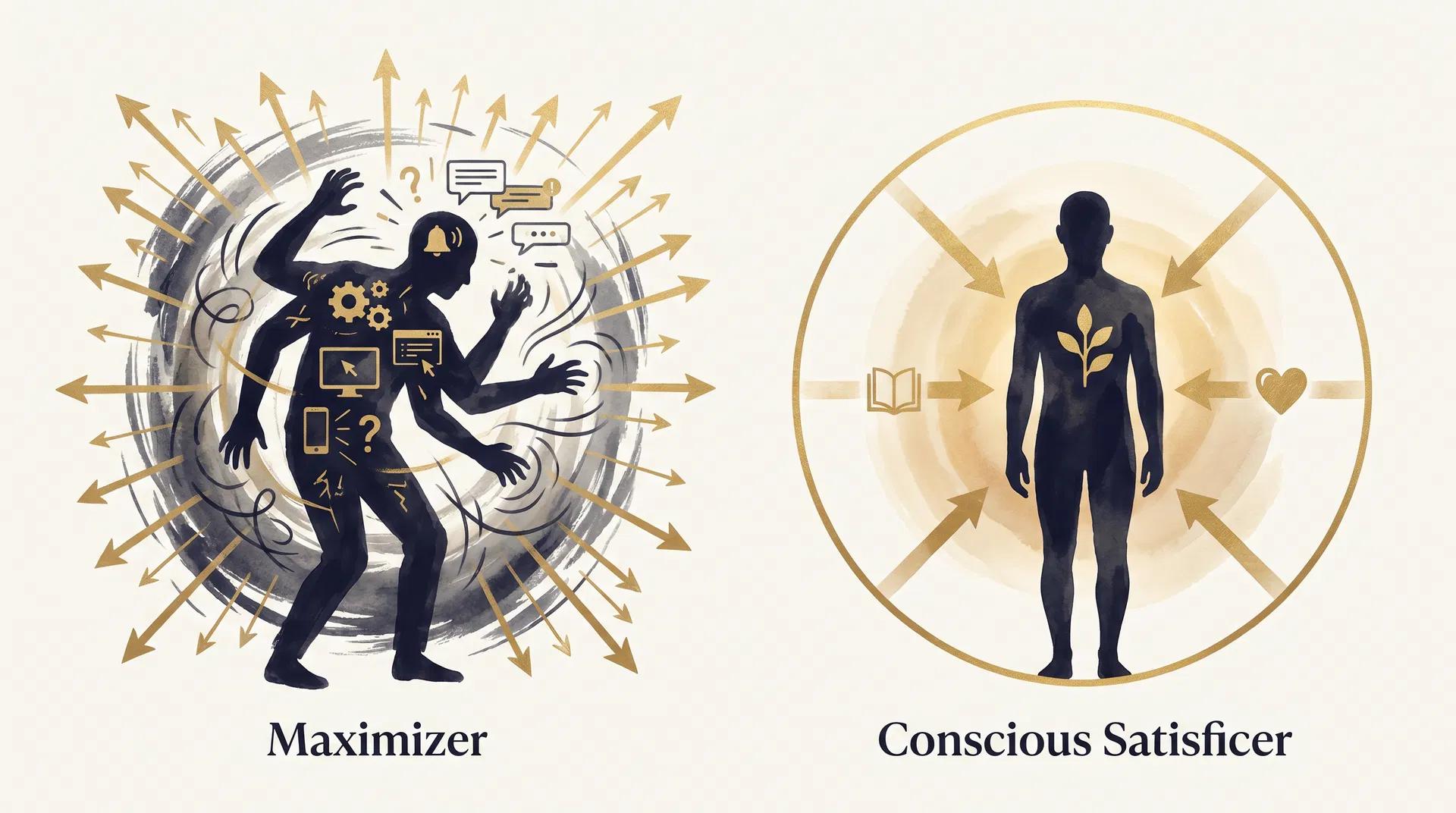
The psychologist Herbert Simon coined the term "satisficing" in 1956 — a portmanteau of "satisfy" and "suffice." His insight was that humans do not optimize; they satisfice. They search until they find something good enough, then stop. The modern attention economy has weaponized the Maximizer tendency: the belief that the optimal choice exists, that you have not found it yet, and that the next scroll will deliver it.

A Maximizer is someone who must find the best possible option before making a decision. They research exhaustively, experience decision paralysis, and feel regret even after good outcomes because they wonder if something better existed. The optimization machine loves Maximizers. It feeds them infinite options and infinite regret.

A Conscious Satisficer is someone who has defined their own criteria for "enough" in advance, searches until they find something that meets those criteria, and stops. Not because they are lazy. Because they understand that the search itself has a cost and that cost is the product the machine is selling.

The Seven Principles of Human OS 2.0

  1. Define enough before you start searching. The machine cannot exploit a person who already knows what they want.
  2. Attention is the only non-renewable resource. Money can be made again. Time cannot. Attention is time made granular.
  3. The algorithm is not neutral. Every recommendation system has an objective function. That function is not your flourishing.
  4. Friction is a feature, not a bug. The things worth doing are hard to start. The things the machine wants you to do are frictionless by design.
  5. Boredom is data. The discomfort of an unoccupied mind is the signal that you are present. The machine wants you to interpret that signal as a problem to be solved with content.
  6. Your operating system is not fixed. Maximizer and Satisficer are not personality types. They are habits. Habits can be changed.
  7. Only time buys trust. In relationships, in work, in your own inner life — depth requires duration. The machine sells the simulation of depth at the speed of a swipe.

Built on A Living Declaration

Human OS 2.0 is built on A Living Declaration — Tony Greenberg's foundational document on agency, systems, and the architecture of a life worth living. The Declaration is the philosophy. Human OS 2.0 is the operating system. The diagnostic is the first step.

Tony Greenberg has been building at the intersection of technology, capital, and consciousness for 25 years. He founded RampRate in 2000 and spent two decades proving that enterprise technology pricing is mostly theater. ImpactSoul is the current argument: that regenerative business is not idealism, it is the better business model. His thesis is three words: Only Time Buys Trust.

Human OS 2.0 is the personal application of that thesis. If you cannot trust your own attention, nothing else you build will hold.

Read A Living Declaration | About Tony Greenberg | Take the Diagnostic