A Living Declaration
The Measurement of Becoming
This is a working declaration, not a new religion. I am interested in a simple question: how do we help people get closer to the life they know they could live? The answers live in the body, in our relationships, in our habits, and in the systems we choose to build.
Add Your VoiceFor twenty-five years, I have built companies, picked apart bad incentives, invested in difficult ideas, and written about what happens when you refuse to accept the world exactly as it is handed to you. Some of that work has involved enterprise contracts, some has involved medicine, some has involved fossils and oceans. It has all been an attempt to find the people and systems worth betting on.
Underneath all of it is one question: What helps a person live with more clarity, more agency, and more room to become who they are?
This is not my final answer. It is a set of working principles, and I expect it to change when somebody smarter than me shows me a better way to think about it. The best work I have done has always been improved by people willing to take me to school.
The Talk That Started It All
At a Humanity+ conference at Harvard in 2010, I shared a stage with Ray Kurzweil during the high-water mark of tech optimism. I was excited by the possibility too. I was also already worried about what happened when the business model was to keep people staring at the machine.
I warned about the slow drift toward smaller print, worse products, and another dollar squeezed from every interaction. The danger was not one dramatic betrayal. It was the thousand tiny tradeoffs that make life meaner while we are busy admiring the convenience.
Two years later, I wrote about the Human Operating System. My point was blunt: artificial intelligence is no match for natural stupidity, and technology should fit human beings like a glove, not a cast. That still feels like a useful test.
I am less interested in claiming prophecy than in noticing what is right in front of us. The tools have become startlingly powerful. That does not automatically make us wiser, kinder, or less lonely. It means we have work to do.
The Frog Was Boiled Too Fast — and Can Still Jump
The speed of change has at least made the problem harder to ignore. Tristan Harris, former Design Ethicist at Google, calls it "human downgrading": products tuned for engagement instead of attention, judgment, or peace. Aza Raskin, who helped create the infinite scroll, has spoken openly about the cost. Their warning is simple: we should not confuse a tool that captures us with a tool that serves us.
I know Tristan and Aza, and I am glad their work is getting a wider hearing. It gives the rest of us a chance to stop pretending that convenience is neutral.
"What we really need are people who grieve their way through the full metabolism and recognition of the metacrisis. And on the other side of that grief is the love you have for the world — post-tragic optimism, which is coming from love to protect that world as best as possible, being in service of that, but unattached to the outcome."
I did not write this to make anxiety into another product. Fear is easy to sell. It keeps people scrolling, arguing, and handing over their attention. I am more interested in what we can do with the piece of life directly in front of us.
I offer something smaller and harder: agency at human scale. Know what you value. Put your attention there. Build enough steadiness to make your own decisions. Then help somebody else do the same.
Old Ideas, Still Useful
The traditions that lasted tend to return to the same unglamorous things: moderation, community, presence, and enough. The Stoics wrote about it. Buddhists wrote about it earlier. You do not need a new app to understand the basic assignment.
Alvin Toffler warned about too much choice. Later, Barry Schwartz gave the problem a name in The Paradox of Choice: maximizers keep searching for perfect, while satisficers know when good enough is genuinely enough. That is not laziness. It is a way of keeping your life from becoming a series of browser tabs.
"The illiterate of the 21st century will not be those who cannot read and write, but those who cannot learn, unlearn, and relearn."
Not Commandments. Invitations.
For those who feel they can't get their head above water, here's an imperfect start.
Choose satisficing over maximizing.
Write down what is good enough. When you get there, stop. Endless comparison is a game designed to keep you dissatisfied.
Embrace voluntary simplification.
Make your life a little less complicated before life does it for you. Fewer accounts, fewer things to maintain, and a few deeper relationships can be a very good trade.
Build at human scale.
Put real effort into the people who know you well and show up when it matters. Big systems come and go. Your close circle is the part you can actually tend.
Redefine abundance.
Abundance is not simply having more. It is having enough room, enough health, and enough agency to make a decent choice. Ask less often, "Do I have enough?" and more often, "What am I making possible?"
Let the titans compete.
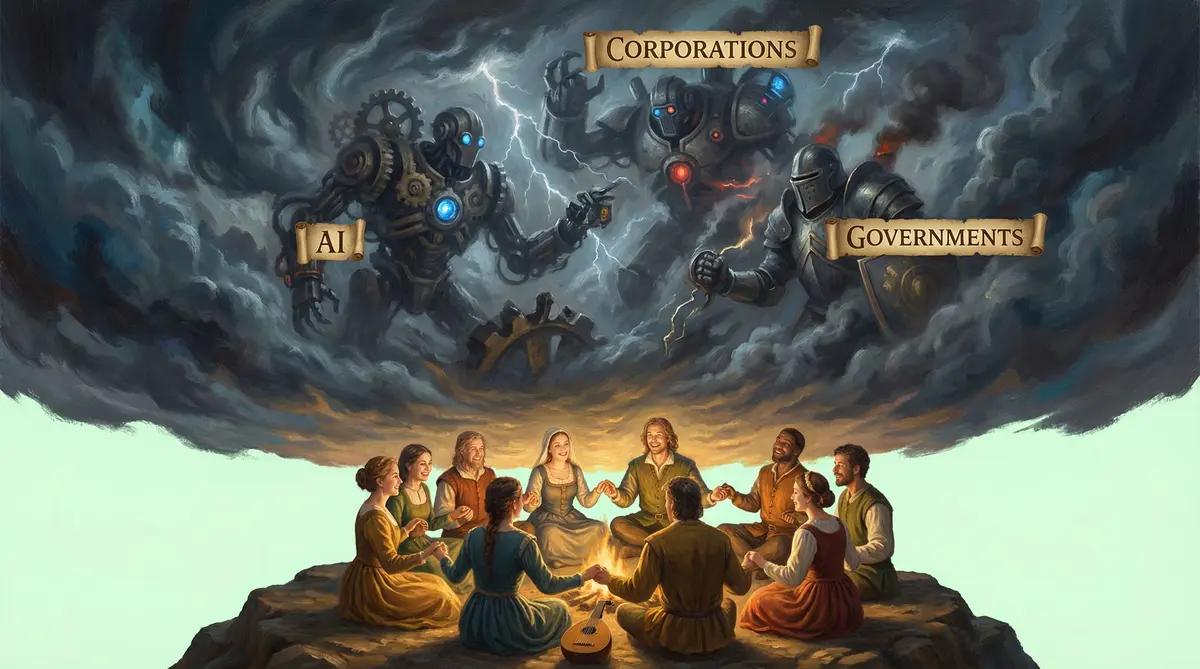
Large companies, governments, and AI systems will fight for dominance. You do not have to make their contest your whole life. Put your energy into the people and places you can actually affect.
Love more, need less.
Real love, attention, and friendship are not small things. They are the parts of life that resist being turned into a product, and they are worth protecting.
For Every Rule, There Are Exceptions
This framework assumes baseline security. If you're in survival mode, meet basic needs first. Satisficing is not settling. The satisficer chooses sufficiency from clarity. The settler accepts inadequacy from exhaustion. Know when to maximize. Don't satisfice on safety, health, or ethics. Maximize your child's blossoming. Maximize your closest relationships. Satisfice on secondary decisions that drain bandwidth without adding meaning.
Specific Steps to Take Today
On your information diet: Limit news to one focused session daily. Eliminate notifications except direct messages from people you know.
On your finances: Maintain 6-12 months liquidity. Avoid debt that creates dependency. Invest in resilience — skills, relationships, community.
On your relationships: Quality over quantity. Depth over breadth. Difficult conversations now, boundary-setting now, repair work now.
On your mind: Invest in practices that restore your nervous system: meditation, nature, exercise, connection, sleep. These are not luxuries. They are infrastructure.
Start by getting yourself a little steadier. Like the oxygen-mask instruction, it is hard to help anyone else if you cannot breathe. Then bring what you have learned into the systems around you.
When I build ImpactSoul, I am trying to prove that making a living and doing some good do not have to be enemies. The work is messy. That is fine. It is better than waiting for a clean theory.
Balaji Srinivasan — crypto-philosopher and architect of The Network State — offers the maximizer's complement to this framework. He's building a startup society prototype near Singapore, arguing technology should "reduce the barrier to exit" by giving people alternatives to broken systems. But we converge on a crucial point: a startup society must be "about community culture first, and technological innovation second." Technology serves values, not the reverse.
Balaji is building a new airplane. I am asking you to secure your oxygen mask first. Find your center. Then build something worth sharing.
Recommended Reading
For those who want to understand the man racing to build the future before we've decided what it should look like, read The Optimist: Sam Altman, OpenAI, and the Race to Invent the Future by Keach Hagey of the Wall Street Journal. Written with Altman's cooperation but no hagiography — it lets you see how thoroughly Silicon Valley has absorbed its own mythology, and why that matters for everything this Living Declaration is about.
"The danger is that if we invest too much in developing AI and too little in developing human consciousness, the very sophisticated artificial intelligence of computers might only serve to empower the natural stupidity of humans."
The weather is already rough in plenty of places. You cannot control all of it. You can decide what you pay attention to, what you make, and who you stand beside. Get steady enough to be useful. Then make the road a little easier for the next person.
Start where your feet are.
Most of the decent things I believe were smuggled in through conversations: an argument over coffee, an advisor who called bullshit, a friend who did not let me off the hook. Even the people who signed up for my bag of cookies have had a hand in this.
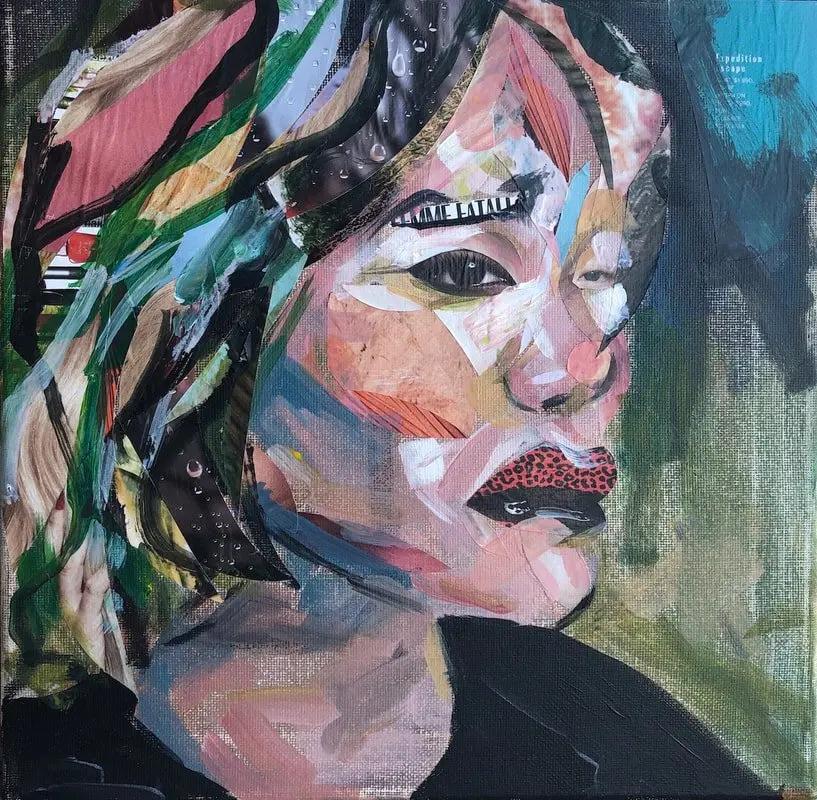
These ideals are belief systems: thoughts attached to feelings. This construct was brought out by Arnold Patent in his seminal book You Can Have It All — do buy and read it. I'm also shaped by Ram Dass, after studying with him for much time in Maui. And I'm profoundly influenced by my partner and glorious artist Clarisse Abelarde, whose work is shown here as a constant inspiration to my creativity and my love for humankind.
Advisors, skeptics, artists, and people who saw something before I could name it have all left fingerprints here. The Human OS is not a finished system and it is not mine alone. It is a pile of useful questions, gathered from people willing to argue in good faith.
No one gets through a strange century by themselves. We will need the patience to learn, the courage to change our minds, and enough humility to admit we do not have the formula yet.
To everyone who contributed — whether you know it or not — thank you. You are the operating system behind the Operating System.
What We Believe. What We Build. What We Measure.
Measure What Matters
The number I care about is not productivity, output, or GDP. It is the distance between the life someone has and the life they know they could be living. If we are going to measure anything, let it be whether the tools, habits, and people around us are helping close that distance.
Take Care of the Body
A tired, anxious, inflamed body makes everything harder. So does treating every new protocol like a miracle. I am interested in the patient work: better information, better questions, careful experimentation, and qualified medical guidance when it is needed. The point is not to become a project. The point is to feel more present in your own life.
Use Less. Live More.
I do not think a better life requires a larger pile of stuff. It requires less waste, less extraction, and fewer systems that turn people and places into inputs. A good life has room for health, friendship, useful work, beauty, and time. If we can get more of that while doing less damage, that is a trade worth making.
Find Your People
We are surrounded by ways to connect and strangely starved for real connection. I am not interested in another feed. I am interested in the people you call when something breaks, the collaborator who makes your idea better, and the friend who tells you the truth. Most meaningful things begin when two people who should have met finally do.
Tell the Truth About the Score
Measurement can be useful when it keeps us honest. It can also become a costume. The work here is to make useful mirrors: ways to see where a team is stuck, where an idea is thin, or where a health question needs a better answer. I want the score to start a better conversation, not end one.
Make It With People, Not At Them
This page is a work in progress, not a sermon from a mountaintop. Tell me what I have missed. Tell me what does not hold up. Tell me what you would build if you had more help and fewer hoops to jump through. The best ideas get better when someone has the nerve to challenge them.
"The goal is not more GDP. The goal is less. Less extraction. Less waste. Less of the frantic production-consumption cycle that's cooking the planet and hollowing out the species."
This Isn't Theory. It's Already Being Built.
These ideas are not just words on a page. They show up in projects, essays, investments, experiments, and conversations that are already underway. Some will work. Some will need to be dismantled. All of them are open to scrutiny.
The QPR Index scores intellectual rigor across 91 essays. The Flow Circuit maps team performance. Human OS V2.0 diagnoses decision-making patterns. The Gem Spark maps serendipity.
The Regenerative Protocol tracks biological optimization. SoulSmoke and LiquidSun honor what enters the body. Sacred Waters maps the molecule that remembers.
The Dairy Tax calculated the true carbon cost of cheese. ImpactSoul tokenizes assets for ocean cleanup. FusionRamp/STRATUM bridges Web3 to enterprise reality.
The Intimacy Assessment maps your relationship intelligence. The Relationship Circuit threads four essays on love. The community invites you to find your tribe.
Homeaglow Exposed holds corporations accountable. Vancefolio enforces portfolio intelligence. Every essay is scored, rated, and open to reaction.
This page. The Life Assessment below. Find Your Journey maps your path. The community you build here becomes the infrastructure for what comes next.
"The old world is falling apart. The new world is being born. In between, there is a great deal of confusion and suffering. But this is also a time of tremendous opportunity — to let go of what no longer serves us and to create something beautiful."
Are You a Conscious Satisficer?
This is not a personality label. It is a chance to notice how you make decisions, what technology is doing to your attention, and where you might be making life harder than it needs to be. Take it if that sounds useful. Leave it if it does not.
Take the AssessmentTell Me Where I Have This Wrong
This is an open notebook, not a survey. Answer one question or all six. Tell me what you are trying to solve, what you wish existed, or where this whole thing gets too precious. Honest answers are useful, especially the inconvenient ones.
The Next Step
Bring Your People Into the Room.
Invite the people you care about. There may be a conversation, a collaborator, or an unexpected connection worth making. At minimum, it is better to build with people you trust than to shout into the void alone.
Enter the Community