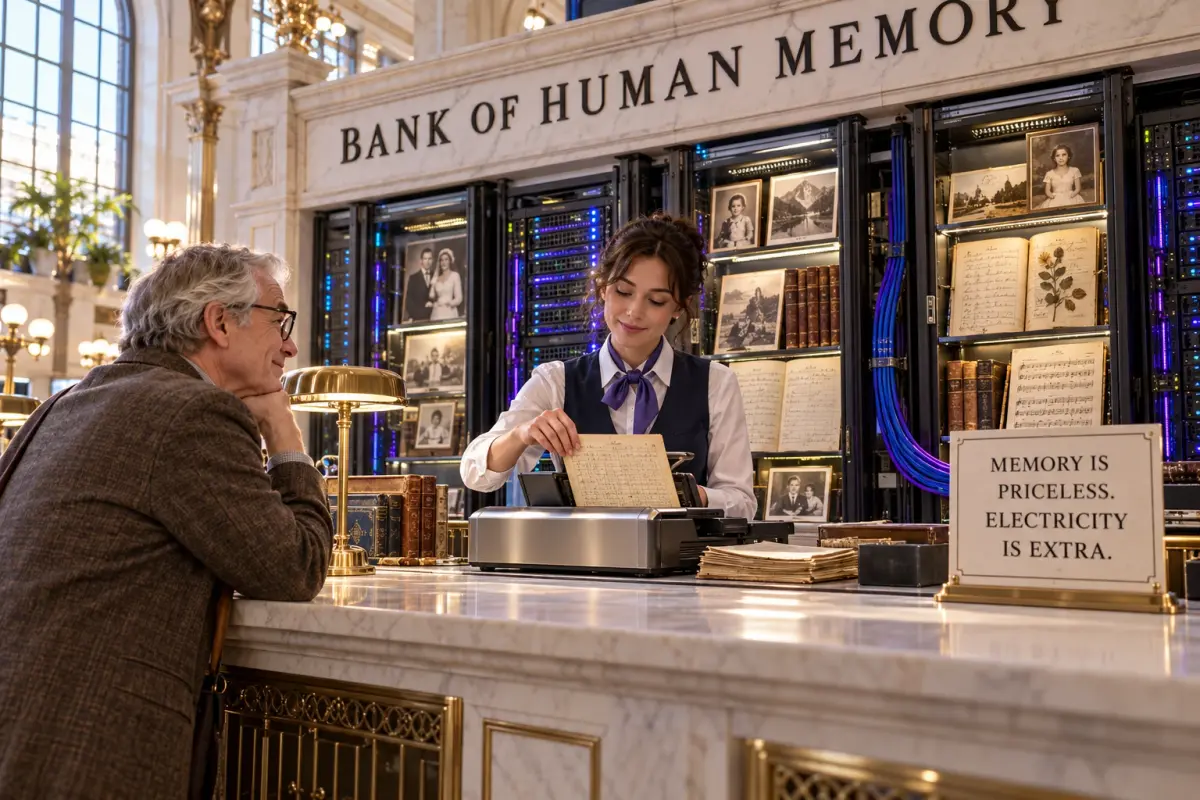
The AI buildout is a compute story with a power bill. Who controls the infrastructure, and who benefits from what it preserves?
The Parallel Nobody Sees
Money remembers. It records a claim: what you earned, what you can buy, what somebody owes you. That is one of its oldest jobs.
Now look at the data center. Electricity powers the machines that store our records and train models on what we have written, photographed, recorded, and discovered. More electricity makes those systems available when we ask them a question.
That is the connection I mean when I say energy becomes memory. Money gave us a portable record of economic claims. Electrified computing lets us preserve and work with a much larger record of human activity. Money still pays the bill. The memory business has acquired a power meter.
The shorthand is provocative on purpose. These are connected functions, not interchangeable substances. A dollar is not a watt. A model is not a mind. But the question underneath them is the same: who gets to keep the record, and who gets access?
What I know about money is that it keeps getting erased
I have made and lost more money than most people on this planet will ever see. Not once. Several times, in both directions, and I have never gotten used to either one.
My own website says I was wrong about the timing and right about everything else for twenty-five years. That is a joke I wrote about myself, and it is also the most expensive sentence in my life. Being early is indistinguishable from being wrong right up until it isn't, and the market settles up in cash long before it settles up in credit.
I put the first URL on live television. I built webcasts before anyone was watching. I was making online video half a decade before YouTube existed. Every one of those was correct. Several of them were catastrophic.
So I have had reason to think carefully about what money actually is, because mine kept disappearing.
Here is what I concluded. I wrote it down in 2010 without understanding what I had written. I opened an essay with the old parable about Heaven and Hell; same room, same table groaning with food, same four-foot utensils too long for anyone to feed themselves. In Hell everyone starves holding a full spoon. In Heaven they reach across and feed each other.
I thought I was writing about business relationships. I was actually writing about accounting. The only thing that distinguishes the two rooms is whether the people in them remember each other.
I have watched my net worth go to a number I will not repeat and then go to something considerably worse than zero, and the thing that never moved through any of it was the ledger nobody keeps in dollars. Who picked up the phone. Whose call I returned in 2004 and who returned mine in 2011 when I badly needed it. What people remembered I had done for them when I could no longer do anything for them at all.
The money was erasable. The memory was not.
That is not a greeting card. It is a balance sheet observation. And it is the same argument I have been making since the long spoons. I just finally found the physics underneath it.
1926: Soddy says wealth is energy
Frederick Soddy won a Nobel Prize in chemistry and then, to the considerable annoyance of economists, wrote a book about money.
In Wealth, Virtual Wealth and Debt (1926), he made an argument that was ignored for fifty years and has aged like a threat. Real wealth, he said, is what you get when you apply energy to matter and transform it into something useful; buildings, food, machines. Everything else is virtual wealth: money, credit, debt, claims on other people's future output.
He was treated as a crank for decades. But Soddy did not say energy is like money. He said money is a shadow cast by energy, and confusing the two is how civilizations get into trouble.
Hold that.
1998: An economist explains money as memory
There is a paper by Narayana Kocherlakota with one of the great titles in economics: Money Is Memory. The argument is austere and, once you see it, unforgettable.
“money is equivalent to a primitive form of memory.”
Narayana Kocherlakota, “Money Is Memory,” Journal of Economic Theory, 1998. Federal Reserve Bank of Minneapolis: Money Is Memory
Kocherlakota establishes the money-and-memory connection within an economic model. I am extending that lens to the physical infrastructure behind machine memory. He did not write my conclusion for me.
Anything money can do, a perfect communal record of who did what for whom could also do. Money is not a thing. Money is a technology for remembering obligations in a society too large to remember them personally.
David Graeber came at it from anthropology and landed in the same place. Credit came first. Coins came later. Before there was currency there were ledgers, tallies, debts held in the head of a village. Money is what we invented because we could not remember each other at scale.
So run the chain:
| Step | Intellectual foundation | What It Means |
|---|---|---|
| Energy → Production | Soddy (1926); Satoshi (2009) for proof of work | Energy enables production. Proof of work helps secure Bitcoin’s ledger; electricity expenditure does not establish its market value. |
| Money → Memory | Kocherlakota (1998), Graeber (2011) | Money records economic claims and obligations. Kocherlakota’s equivalence is established within an economic model. |
| Energy → Computing and Storage | Tony’s extension of the economic lens to computing infrastructure | Electricity powers computation and storage. Model inference is not faithful archival retrieval. |
2009: Satoshi puts proof of work on the ledger
Bitcoin makes the energy cost of securing a transaction record visible.
Proof of work uses computational effort to make rewriting Bitcoin’s transaction history costly. That helps secure the ledger; it does not determine Bitcoin’s market price.
Bitcoin made the relationship between electricity expenditure and digital scarcity unusually visible.
And here is the part the industry took fifteen years to notice. The miners were never really in the mining business. They were in the business of acquiring energized land with grid rights during a period when nobody else wanted it.
The building was often not the scarce asset. The connection was.
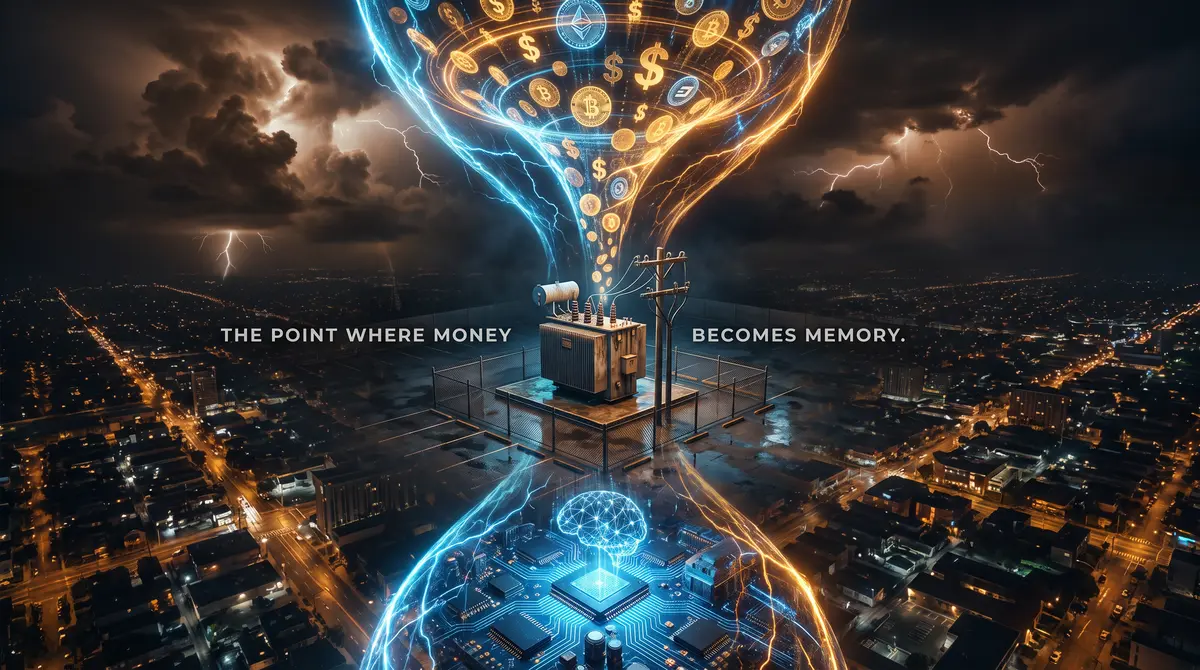
The narrow neck is not the chip. It is not the building. It is the transformer in the parking lot; a steel box on a concrete pad; and behind it, a filing cabinet at a regional grid operator. Electrical equipment is under ten percent of data center cost and one hundred percent of the bottleneck.
2026: Computing acquires a power bill
Here is what an AI training run actually is, stripped of the mythology.
Training adjusts model weights using data and computation. Inference uses those learned parameters to generate outputs. This is not the same as retrieving a faithful archive; preservation also requires maintained records and storage.
The IEA’s 2025 Energy and AI report estimated that all data centers used roughly 415 terawatt-hours in 2024 and projected about 945 terawatt-hours by 2030 in its Base Case, just under three percent of global electricity consumption. These are the report’s historical estimate and projection for all data centers, not solely AI or memory.
Computation and storage have become major line items on the grid.
New generation and storage face their own grid constraints. Berkeley Lab found that, of generation and storage capacity submitting interconnection requests from 2000 through 2019, 13% had reached commercial operation by the end of 2024, 77% had been withdrawn, and 10% was still active.
This is a generation and storage queue cohort, not a count of data centers waiting for power. Withdrawn capacity is not still waiting in the queue.
The memory business just ordered more electricity
On October 6, 2026, Google and Constellation announced a deal to add 890 megawatts of nuclear capacity through upgrades to existing plants. The wider arrangement includes another 2,700 megawatts of supply. That second number is not another 2,700 megawatts of new nuclear generation. The distinction matters.
An AI company signing a long-term power deal is putting a very expensive underline beneath this argument. The software needs a physical place to run, and that place needs electricity.
Four days earlier, Amazon announced more than $1 billion in additional investment over five years for communities hosting its data centers, covering priorities including education, job training, energy affordability, and resource preservation.
Those are commitments. The receipts come later.
The cloud has neighbors. They deserve to know who pays for grid upgrades, what happens to their bills, how water is managed, and what remains in town after the construction crews leave. A ribbon-cutting photograph is not a community benefit agreement.
My point is not that every data center is a public gift or a public menace. Read the contract. Count the costs. Track the benefits. Then decide.
Sources:
Memory has always been expensive. That is the whole problem.
Before the printing press, remembering anything required a human being to spend a life copying. Monasteries were memory infrastructure. The energy source was calories and devotion, and the throughput was one manuscript at a time. What survived antiquity was not what was most true or most beautiful. It was what somebody was willing to feed a scribe to keep.
Knowledge can disappear when the people and institutions carrying it lose support. Power and storage help, but so do teachers, translators, archivists, and communities willing to keep it alive.
What we remember has never been decided by what is worth remembering. It has been decided by who was willing to pay the energy bill.
Now the bill is a power purchase agreement and the scribe is a GPU. The mechanism did not change. Only the scale, and the honesty of the accounting.
What is not digitized, translated, funded, or commercially legible is less likely to survive this new memory economy. Languages, local knowledge, oral traditions, and entire ways of seeing the world can disappear before the model ever has a chance to learn them.
The provocation
Money records claims. Electricity enables computation and storage. Allocating power shapes who can operate those systems at scale.
Which means every gigawatt contract signed this year is a vote on what humanity keeps.
Nobody is casting that vote consciously. There is no committee. There is a queue at a regional transmission organization, a backlog at a turbine manufacturer, and a spreadsheet at a hyperscaler. The most consequential curatorial decision in human history is being made by procurement.
And the thing being remembered is overwhelmingly whatever was already legible to the training pipeline; which is to say, whatever was already written down, already digitized, already English.
Money helped us remember what we owed one another. Electricity now powers machines that preserve and recombine far more of what we know. That is the payoff: a familiar problem of control and access has acquired an enormous physical footprint.
That capacity should buy something useful for the people around it: lower costs, access to knowledge, less wasted effort, more time to live. None of that is guaranteed by a faster chip.
Community ownership, revenue sharing, and tokenization belong here only when they give people clear rights and a credible share of the benefit. If the rights are vague, the token is a souvenir.
We can build extraordinary machines and still be lousy at sharing the table. We have had practice.
The long spoons are back. The table is full. The question is whether we remember to reach across it.
What do you think?
Access to reliable power helps determine which systems can operate at scale. What they preserve also depends on data, language, consent, funding, and human choices.
I have been sitting with this argument for a while and I am not sure I have the conclusion right. Here is what I am genuinely uncertain about:
Is the allocation of memory capacity the most important political question of the next decade; or am I overstating it?
If you work in energy, infrastructure, AI, or you have just watched something disappear because nobody could afford to remember it; I want to hear from you. Reply to this, or find me at tony@impactsoul.is. I read everything.
Keep Reading
- Business at the Speed of Light; What Is a Millisecond Worth?; RampRate's 2011 piece on the I/O bottleneck. The bottleneck moved. The argument didn't.
- The $1,000/Hour Hold; A Manifesto Against the Companies That Steal Your Time; What happens when systems are optimized for the wrong variable.
- Only Time Buys Trust; The original essay. Memory that survived contact with time.
- Enterprise Blockchain: Can Big Business Co-opt an Existential Threat?; The last time a new infrastructure layer rewrote who controls the ledger.
- Why Good Service Is All About Trust; The accounting that doesn't show up in dollars.
- Human OS 2.0; What happens when intelligence becomes abundant and attention becomes scarce.
Sources
- IEA, Energy and AI
- Berkeley Lab, Queued Up: 2025 Edition
- FERC, Generator Interconnection
- Federal Reserve Bank of Minneapolis, Money Is Memory
- Google/Constellation, nuclear capacity and power agreement, October 6, 2026
- Amazon, Built Together community investment, October 2, 2026
Tony Greenberg is an Impact Futurist, investor, and founder of RampRate and ImpactSoul. He works where infrastructure, capital, and human possibility meet, asking an inconvenient question: who actually gets a better life out of the deal? His work connects enterprise technology with community benefit, cultural preservation, and business models that give more back than they take. He has a soft spot for ambitious builders and very little patience for a tollbooth pretending to be an innovation. Only time buys trust.