
By Tony Greenberg | Published in NUISANCE | May 21, 2026
I found out from friends.
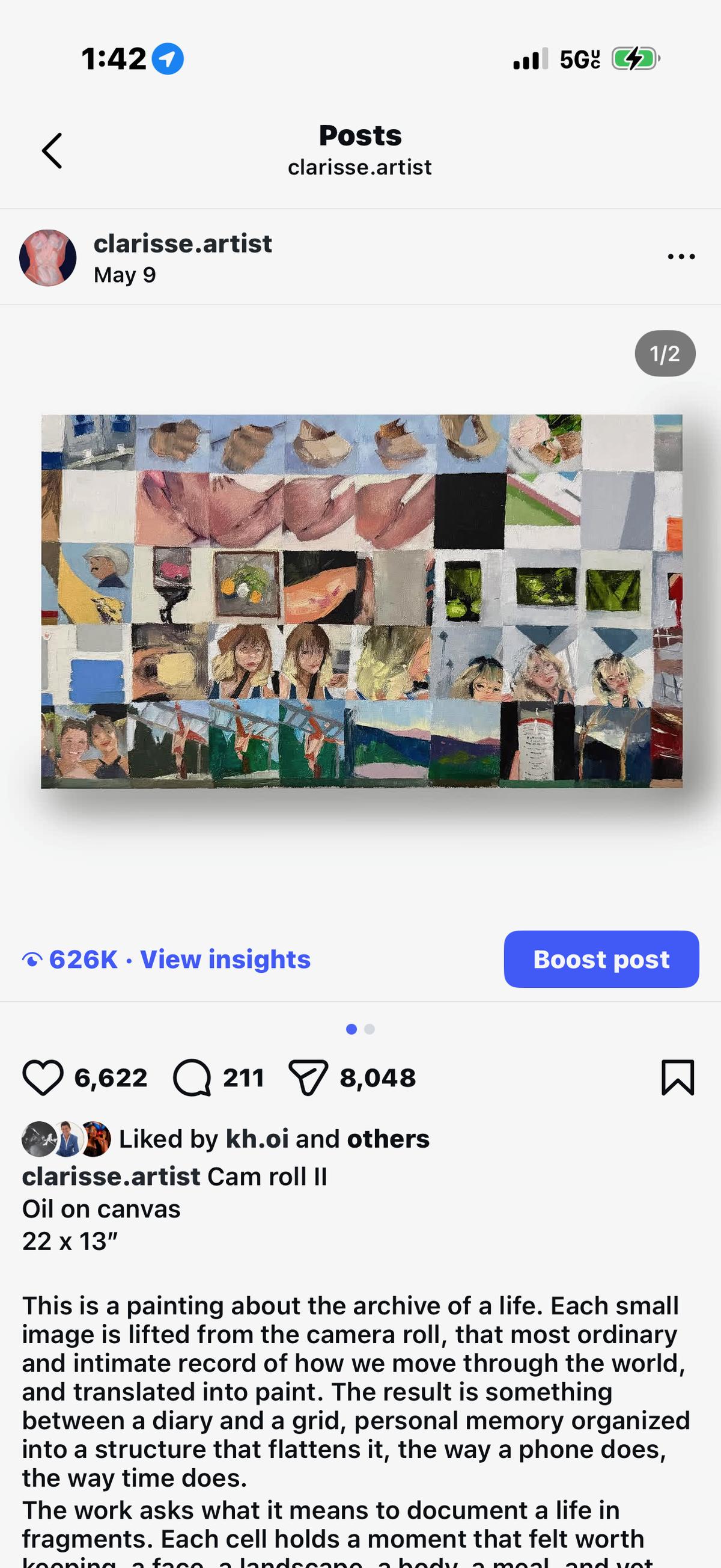
Three or four of them, within an afternoon, sent me the same message in slightly different forms: Did you know you’re making a cameo appearance in the lower left-hand corner of Clarisse’s magnificent painting?
I hadn't known. I'm, by some accounting of these things, an extra in a film I didn't realize was being shot. The lower left-hand corner of an event.
I went to find my beloved. Clarisse Abelarde was in her studio, working on something else. I told her what the friends had said. She nodded, the way she does when something is so obvious to her that she's forgotten anyone might find it remarkable.
I said: you could've shown me this.
She said: it's just from my camera roll. You're in there. Of course you're in there.
Then I asked her, because by then the texts weren't just about the cameo, they were about the reach: how many views have you got?
She looked at the phone. She did the small calculation. She said: almost a million.
There was a long pause.
She said: is that a lot?
Yes, Clarisse. It Is a Lot.
I want to spend this essay explaining why, because my beloved doesn't yet know the magnitude of what she's done. She's so absorbed in the work itself; in the slow, deliberate, palette-knife-by-palette-knife labor of rendering a life honestly, that the metrics around the work are essentially alien to her. She has reached 975,900 people in three days; 626,000 on a single post, and her response is to ask if that constitutes a meaningful number.
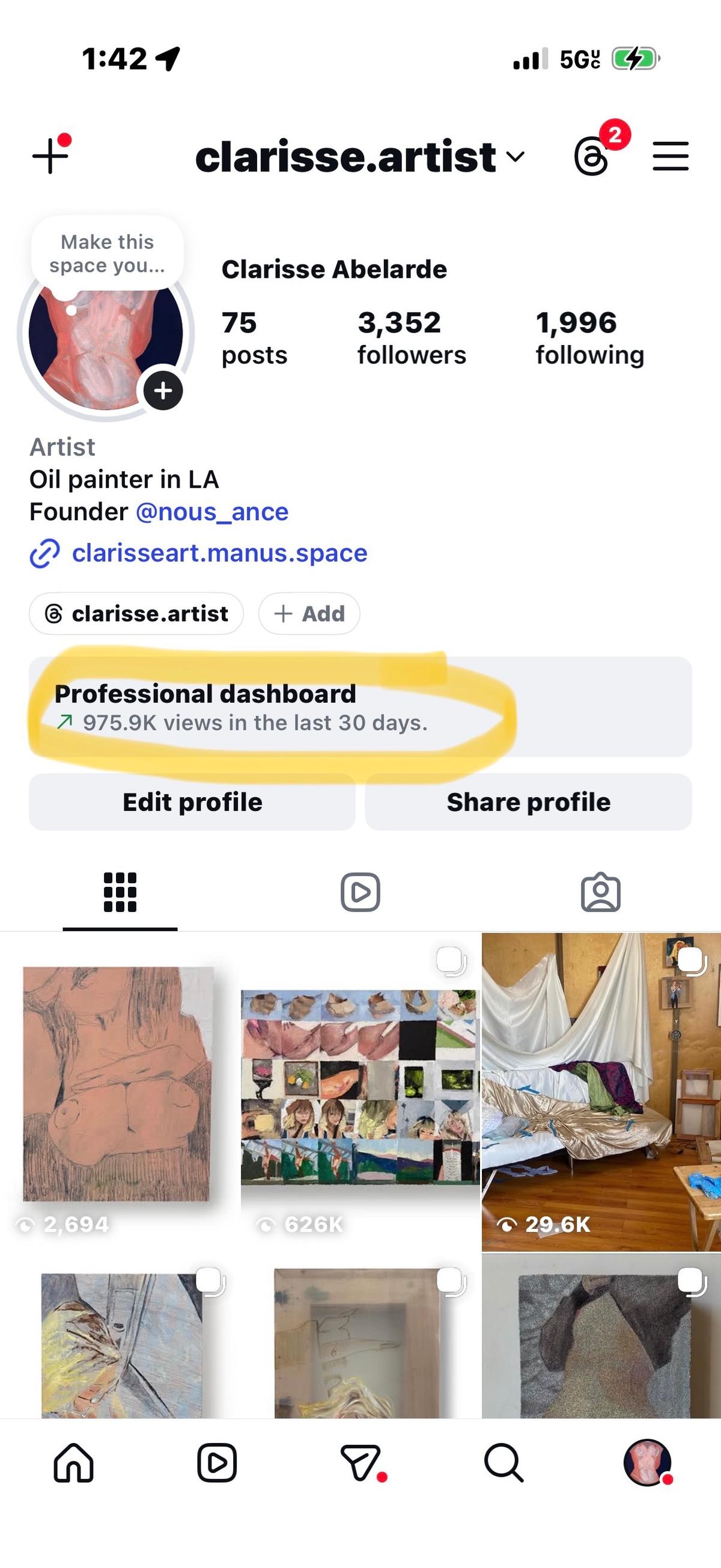
It does. It should've been two million. The platform decided otherwise. I'll get to that, because it's its own small absurdist comedy involving a thirty-thousand-year-old paleolithic statue and an OnlyFans account operated by an Austrian government agency. Stay with me.
What Almost Never Happens in the Art World
Let me describe the typical pattern for how a painter becomes known.
A painter spends years, sometimes decades, building technical command. She develops a body of work. She shows in group exhibitions, then small solo shows, then larger ones. She finds gallery representation. The gallery does the work of placing her paintings with collectors, getting her into art fairs, securing reviews in Artforum and Frieze and the appropriate critical organs. If she's fortunate, after fifteen or twenty years of patient institutional accretion, she becomes one of the painters that serious people know about.
Almost no one becomes known any other way.
The art world is structured around institutional gatekeeping. Galleries, museums, critics, fairs, collectors, biennials; these institutions exist precisely to decide which artists are worth attention. The system rewards patience and connections. It doesn't reward viral moments. It's, in many ways, an entire economy designed to resist them.
Look at the painters of the last twenty years who have broken through to mainstream cultural awareness: Amoako Boafo, Jordan Casteel, Salman Toor, Christina Quarles. Every one of them came up through the gallery system. Every one of them had institutional backing before they had cultural reach. The viral moments, when they came, were downstream of institutional validation, not upstream of it. The figurative-painting boom of the post-pandemic decade, well documented in Artnews and elsewhere, has been gallery-curated from the ground up.
Even Banksy, the supposed counterexample, built his audience through controversy and anonymity, not through unfiltered authenticity. Beeple reached mass awareness through the NFT market, not the painting tradition. The genuine viral moments in serious figural painting; organic, unrepresented, no institution involved; are essentially unprecedented at the scale Clarisse just reached.
To put this in perspective: most museum Instagram accounts, with hundreds of thousands of followers and full curatorial staff, don't get 626,000 views on a single post in three days. The Metropolitan Museum of Art doesn't do it routinely. Neither does the Louvre. Neither does MOCA. The Whitney would consider a million views in a week a meaningful event.
Clarisse did it with seventy-five posts, 3,352 followers, and one painting she made because she had to.
The closest historical parallel might be the moment Édouard Manet exhibited Olympia at the 1865 Salon, scandalizing Paris and becoming famous overnight; except that scandal required a physical exhibition space, an institutional venue, the entire machinery of the Parisian art establishment, and a public ready to faint at the sight of a frankly painted body. Clarisse needed an iPhone and a willingness to be honest. It's not a perfect parallel. Nothing is. We're in genuinely new territory here.
Why This Particular Painting
I want to spend a moment on the work itself, because the rarity of the cultural moment is downstream of the rarity of the painting.
Cam Roll II is twenty-two by thirteen inches. Oil on canvas. Made entirely with a single palette knife across months of sessions; no brushes, no shortcuts, no concessions to the speed that contemporary art so often demands of itself. Each small cell on the picture plane is pulled from her actual phone, the actual archive of her actual life. Food next to friends next to landscapes next to bodies next to the blur of light that makes up a day.
The technical constraint is brutal. A palette knife isn't a fine instrument. It's a tool for moving large quantities of paint quickly; the painting equivalent of trying to perform microsurgery with a butter knife. To render small, detailed images with a palette knife is to fight the tool the entire time. To do this for months, on a single canvas, produces an impasto surface that is simultaneously assertive and uncertain. The medium itself becomes part of the message. Each cell carries the gestural confidence of the knife alongside the patient labor of someone who refused to use a finer tool.
There's something almost slapstick about choosing the wrong instrument deliberately. Like deciding to write a novel exclusively in haiku. The constraint forces a particular kind of seeing.
The conceptual frame is also rare. Painters have rendered private archives before; Sophie Calle, Tracey Emin, an entire lineage running back through the diaristic impulse in twentieth-century art. Painters have made grids of small images before; Gerhard Richter’s Atlas, Andy Warhol’s repetitions, the entire post-conceptualist grid tradition that Rosalind Krauss theorized so memorably in 1979. But the camera roll, as a structure, is specific to the present moment. It's the most intimate archive contemporary life produces; more honest than a journal, less edited than a social media profile, more truthful than any image we've ever chosen to post; and almost no painter has taken it seriously as primary source material.
Clarisse took it seriously. She let the camera roll’s indifference to hierarchy become the painting’s organizing principle. Nothing in the work is more important than anything else. A body has the same weight as a bowl of fruit. A friend’s face has the same weight as a blur of city light. The painting refuses to editorialize about what matters. It says: a life contains all of this, equally, and the truth of a life is what you can't rank.
This is the Clement Greenberg trap inverted. Greenberg argued for medium specificity—painting should be about painting, flatness about flatness. What Clarisse is doing is medium specificity for the iPhone era. The painting is about what only painting can do with the camera roll: hold it still, render it deliberately, refuse to scroll past.
Pablo Picasso once said, in a 1923 interview, “Art is a lie that makes us realize truth, at least the truth that is given us to understand.” This is precisely what's happening in Cam Roll II. The painting isn't the camera roll. The painting is the lie that lets us see what the camera roll actually contains. The artifice of oil paint becomes the vehicle for honesty that the original screenshots could never quite achieve.
I'm in the lower left-hand corner. So is a bowl of food. So is a stranger’s silhouette. So is a moment my beloved thought was worth keeping. The painting holds us all at the same scale, which is to say, the painting tells the truth.
The Hunger Was Already There
I want to pause on something less obvious about what just happened.
Nearly a million people didn't respond to Clarisse’s painting because Instagram showed it to them. They responded despite Instagram. The algorithm was, as we're about to discuss, actively slowing the work. The reach happened anyway because people kept sharing it, kept tagging each other, kept saying some version of: you have to see this.
There's a meaning crisis underway. A slow leak of significance from public life. The two old operating systems; Meaning 1.0, the organized religions of the last two thousand years, and Meaning 2.0, the Enlightenment liberalism of the last three hundred; are both shedding adherents faster than either can replace them, and nothing coherent has yet shown up to take their place. As Jamie Wheal puts it in Recapture the Rapture, what people need now is to “replace blind faith with direct experience.” The engines of late-modern attention have produced a population that is endlessly stimulated and almost never moved; rats hitting the dopamine lever while the deep stories of a civilization quietly drain out the back. We're, as a culture, starving for the unmediated. We're starving for work that refuses to perform for us. We're starving for honesty so unvarnished it feels almost like a small act of violence.
When that work appears, what happens isn't slow adoption. What happens is the cultural equivalent of a hunger response. Nearly a million people in three days isn't engagement. It's what an entire population does when it finally finds something it's been looking for without quite knowing what it was.
The painting isn't just a painting. It's a flare in the dark. People saw it and forwarded it because they recognized something they hadn't known was missing. The camera roll, that most intimate and unconsidered archive, turns out to be a piece of evidence about who we are when nobody is performing.
That's why this happened. The work was extraordinary. The culture was ready. And the algorithm tried to slow it anyway.
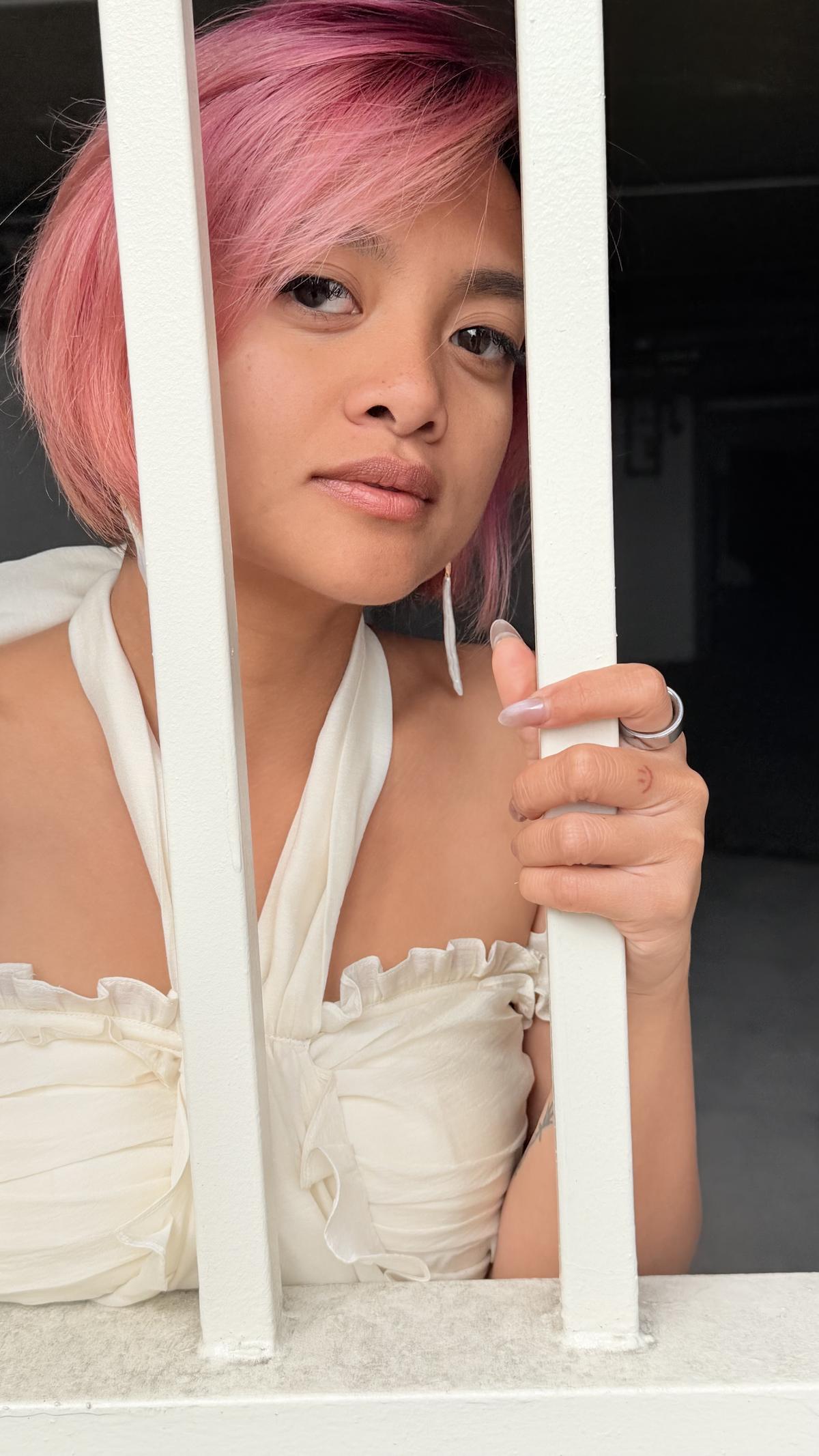 Clarisse Abelarde. Behind bars, as it were.
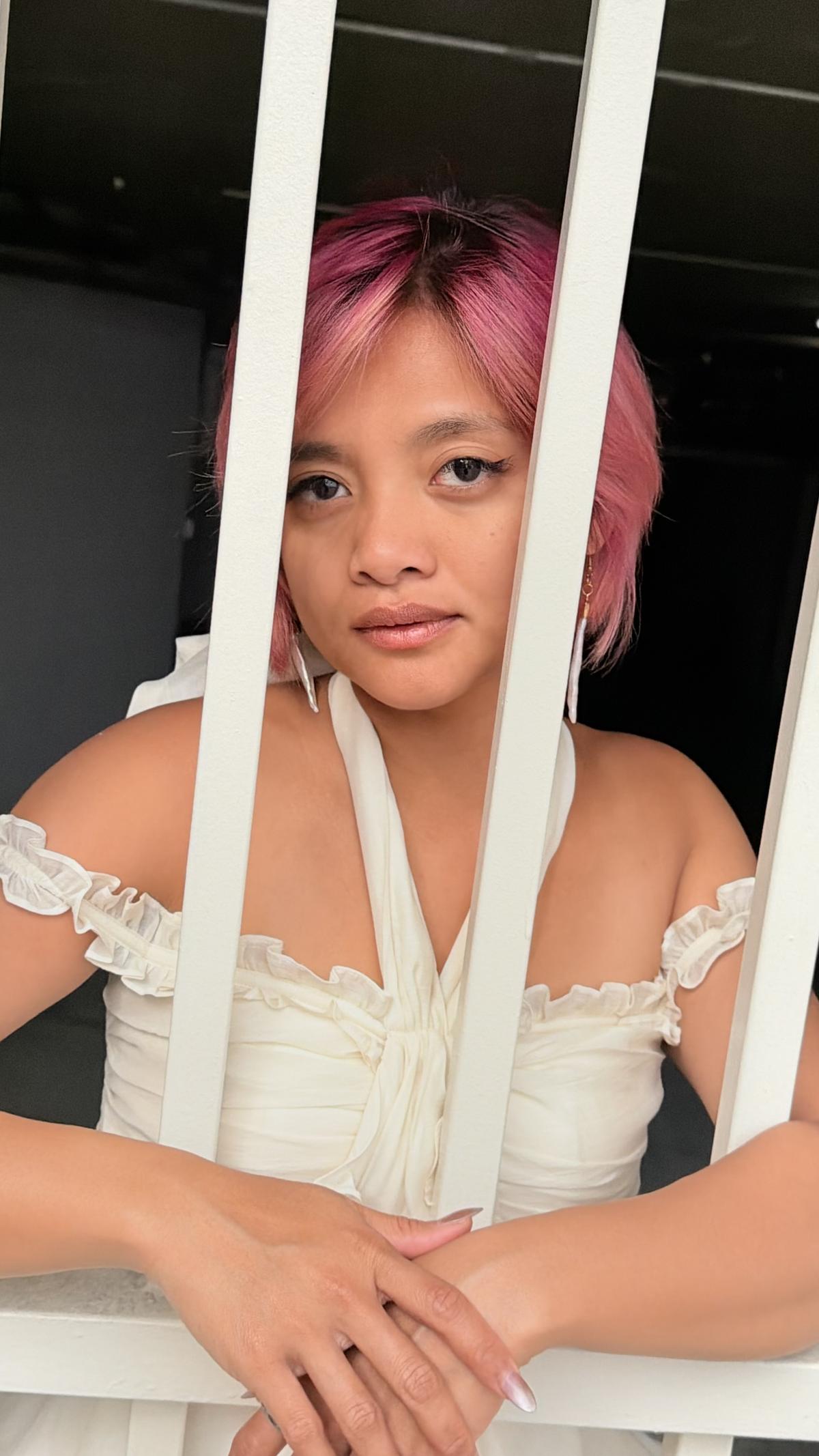
And Then the Algorithm Decided What Else We Were Allowed to See
Here's what I haven't said yet, but must:
The painting reached 975,900 people in spite of being suppressed.
Cam Roll II contains nudity. Tastefully rendered. Artistically composed. The same kind of figural work that appears in every serious art museum on earth, from the Met to MOCA to the Louvre. The same tradition that runs from antiquity through the Renaissance through every century of legitimate Western and global painting. The same tradition that produced Botticelli’s Venus, Titian’s Venus of Urbino, Manet’s Olympia, Modigliani’s reclining nudes, and every painted body that hangs in every gallery from the National Gallery in London to LACMA.
Instagram put a sensitivity screen on it.
The reach slowed. The organic momentum capped. Viewers were required to click through a warning to see the work. 626,000 views on a single post happened despite the screen. A million might've happened without it.
The English art critic John Berger, in his 1972 essay collection Ways of Seeing, drew a distinction that has never been more relevant than it is today. “To be naked is to be oneself,” he wrote. “To be nude is to be seen naked by others and yet not recognized for oneself.” Nakedness, in Berger’s framing, is honesty. Nudity is performance.
Clarisse painted the naked, not the nude. She rendered bodies as part of the truth of a life; not displayed, not performed, not optimized for the gaze. Just: present. The same way bodies are present in any honest archive of any honest life.
Instagram added a sensitivity screen to the naked while it algorithmically amplifies the nude every single day. This is the precise Berger inversion. The platform allows performance. It restricts honesty.
On the Absurdity of Platform Censorship: An Austrian Detour
If you find this hard to believe; that Instagram put a content warning on serious figural painting while permitting daily algorithmic amplification of commodified bodies; I'd refer you to Vienna.
In 2021, the Vienna Tourist Board opened an OnlyFans account.
I'll let you sit with that sentence for a moment.
This isn't a joke. It was reported by NPR, NBC News, ArtNews, and ArtReview. Imagine the meeting. Imagine the moment a roomful of Austrian cultural bureaucrats looked at each other and concluded that the most pragmatic venue for promoting one of Europe’s great artistic patrimonies was a content-subscription platform best known for sex work; there's something almost Wes-Andersonian about it. The cultural attaché of Vienna, gravely opening an OnlyFans account, in defense of Rubens.
The city’s official tourism office moved its promotion of classical art to that platform because Facebook, Instagram, and TikTok kept removing posts featuring works from the Albertina Museum, the Leopold Museum, the Natural History Museum, and the Kunsthistorisches Museum.
Among the censored works: Egon Schiele, the early twentieth-century Austrian master whose work hangs in MoMA and the Tate. Amedeo Modigliani, whose reclining nudes regularly sell at auction for nine figures. Peter Paul Rubens, seventeenth-century Flemish master, foundational to the entire Baroque canon.
Also: the Venus of Willendorf.
The Venus of Willendorf is a four-and-a-half inch limestone figurine carved approximately thirty thousand years ago. It's one of the most important artifacts in human history. It predates writing. It predates agriculture. It predates Mesopotamia, the wheel, the domestication of dogs, and the concept of art as we currently understand it.
Facebook censored it in 2018 for nudity.
Let us pause and admire the absurdist comedy of this. Somewhere in a Menlo Park server farm, an algorithm trained on contemporary content guidelines, deployed by a corporation chartered in 2004, made a determination about a paleolithic limestone carving that has existed for thirty millennia. The algorithm concluded that the prehistoric Venus of Willendorf; the same Venus of Willendorf that sits in a glass case in the Natural History Museum of Vienna, studied by every archaeologist and anthropologist who has ever taken the subject seriously; required protection from the public. A figurine that has survived the last ice age, the rise and fall of every empire in recorded history, and roughly twelve hundred generations of human civilization couldn't survive the Facebook content team’s quarterly review.
We aren't protecting the public from anything by adding sensitivity warnings to thirty-thousand-year-old sculptures. We aren't protecting the public by adding them to serious contemporary painting either. We're doing something else entirely.
The Vienna Tourist Board’s director Norbert Kettner told reporters at the time: “In social media, algorithms determine how much nudity may be shown and often censor world-famous works of art. We question how much nudity we can tolerate and who can determine what we find offensive.”
The Vienna board’s spokesperson Helena Hartlauer put it more sharply: “It might lead to some unconscious self-censorship, when artists start to make art differently or collectors assemble their collections in a different way because they know a tool as strong as social media wouldn't show or promote certain types of art. This is quite frightening.”
She was correct. It's frightening. And it's happening to Clarisse right now.
What the Algorithm Allows and What It Restricts
Let me draw the contrast plainly:
Instagram algorithmically amplifies bikini influencer content optimized for engagement: allowed.
Instagram shows paid posts of commodified bodies designed to sell products: allowed.
Instagram permits suggestive content from accounts with massive followings and verified blue checkmarks: allowed.
Instagram displays a thirty-thousand-year-old prehistoric Venus carving from the Natural History Museum of Vienna: sensitivity screen.
Instagram shows Egon Schiele drawings from the Leopold Museum: post removed.
Instagram carries an oil painting by Clarisse Abelarde depicting her own camera roll: sensitivity screen, reach reduced.
This isn't a coherent content policy. This is a value judgment dressed up as algorithmic neutrality. Commodified bodies serve the platform’s economic model. Honest bodies in legitimate art don't. So one is amplified. The other is restricted. The algorithm isn't protecting anyone from anything. It's enforcing a particular vision of which bodies are allowed to be seen and in what context.
This is what Kettner meant when he asked who gets to determine what we find offensive. The answer in 2026 is: an algorithm trained on a content policy designed by a corporation whose primary obligation is to its shareholders. That algorithm just slowed my beloved’s career.
On What Is Being Quietly Self-Censored
The Vienna Tourist Board’s deepest concern wasn't the individual instances of censorship. It was the unconscious self-censorship that follows. When artists know that the algorithm will restrict certain kinds of honest work, they make different work. When collectors know that certain paintings will be slowed on social media, they collect different paintings. When galleries know that an honest figural artist will hit invisible ceilings, they sign different artists.
The censorship reshapes the art before the art is even made. This is the chilling part. Not the individual post that gets restricted but the painting that never happens because the painter has internalized what the platform will permit.
If Clarisse had known that her painting would be put behind a sensitivity screen, would she have made it differently? I don't believe so. She isn't the kind of artist who calibrates to the algorithm. But the question isn't about her. The question is about all the other artists who might be the next Clarisse, and who might not make their version of Cam Roll II because they know what happens to honest work when it tries to spread.
We aren't just losing reach on individual posts. We're losing the paintings that would've been made if the painters knew the work would be allowed to find its audience. We're losing an entire register of cultural production that requires, as its precondition, the assumption that honest work can find honest viewers without being throttled by something in between. The whole post-tribal, peer-to-peer, ecstatic conversation that this internet was supposed to enable has been quietly pruned by content moderation rules nobody voted on. The bigger we; the one we keep hoping might finally cohere around something true; keeps getting interrupted by a friction layer designed by quarterly earnings reports.
That is the larger censorship. It's invisible. It's unmeasurable. And it's shaping the cultural record of our moment in ways we'll only understand in retrospect.
To the Institutions Who Are About to Notice
I want to address this part of the essay directly to the curators, the gallery directors, the critics, the journalists, the museum acquisition committees, and the editors of the publications that take painting seriously.
Clarisse is the real thing.
The technical command is extraordinary. The conceptual clarity is rare. The instinct for honest representation in an age of curated falsity is the kind of artistic position that defines careers. She isn't a viral moment. She's a serious painter who happened to have a viral moment because the work was that good and the culture was that hungry and the algorithm was insufficient to suppress what wanted to be seen.
She's open to representation. She's open to institutional partnership. She's open to exhibition, to acquisition, to the conversation about contemporary portraiture and the camera roll as archive that her work is now part of whether the institutions have caught up to her or not.
The cultural moment is here. She's in Los Angeles. She's making the next painting already
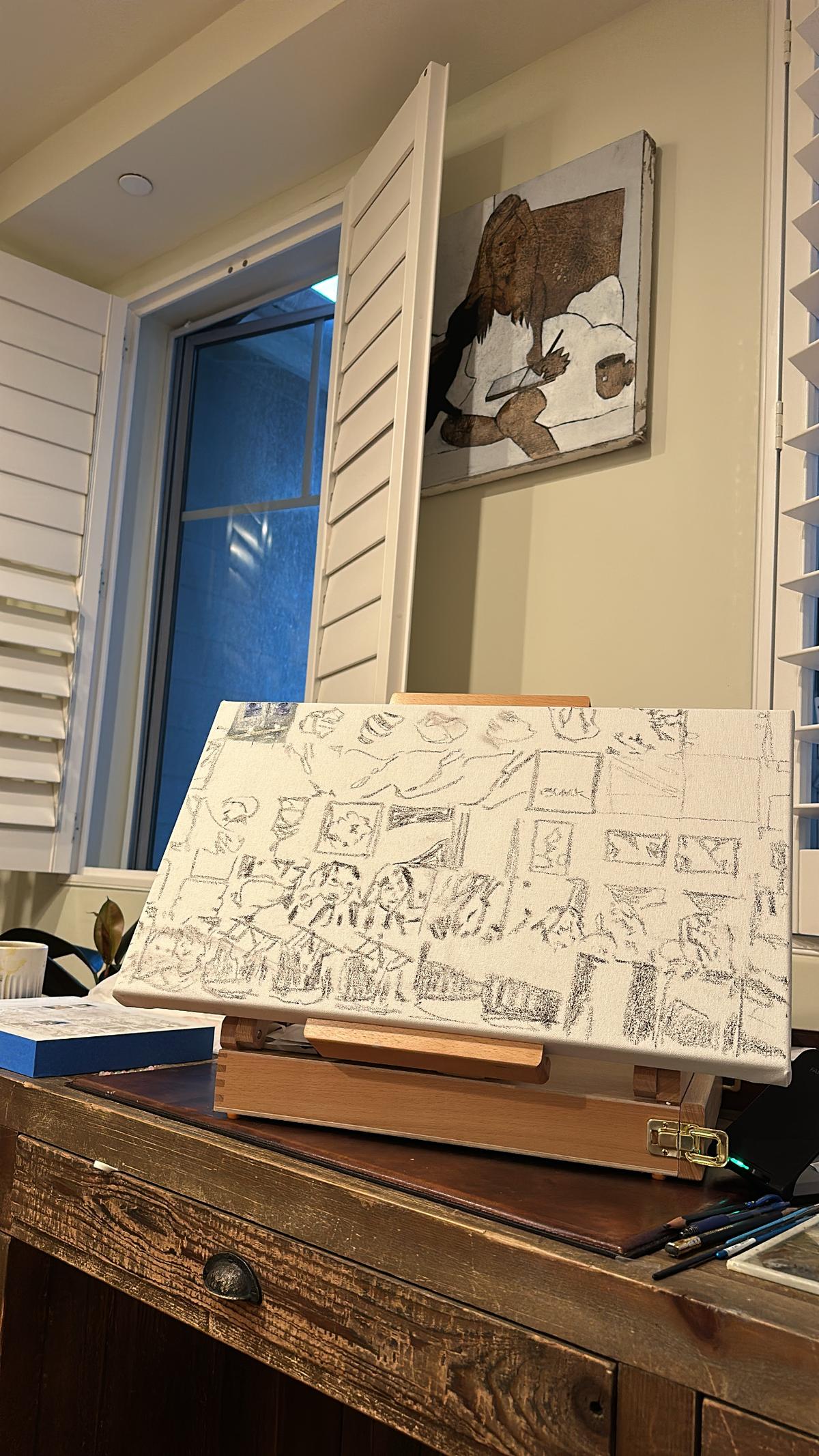 The next painting is already underway. Cam Roll II, pencil on canvas, mapped out on the tabletop easel.
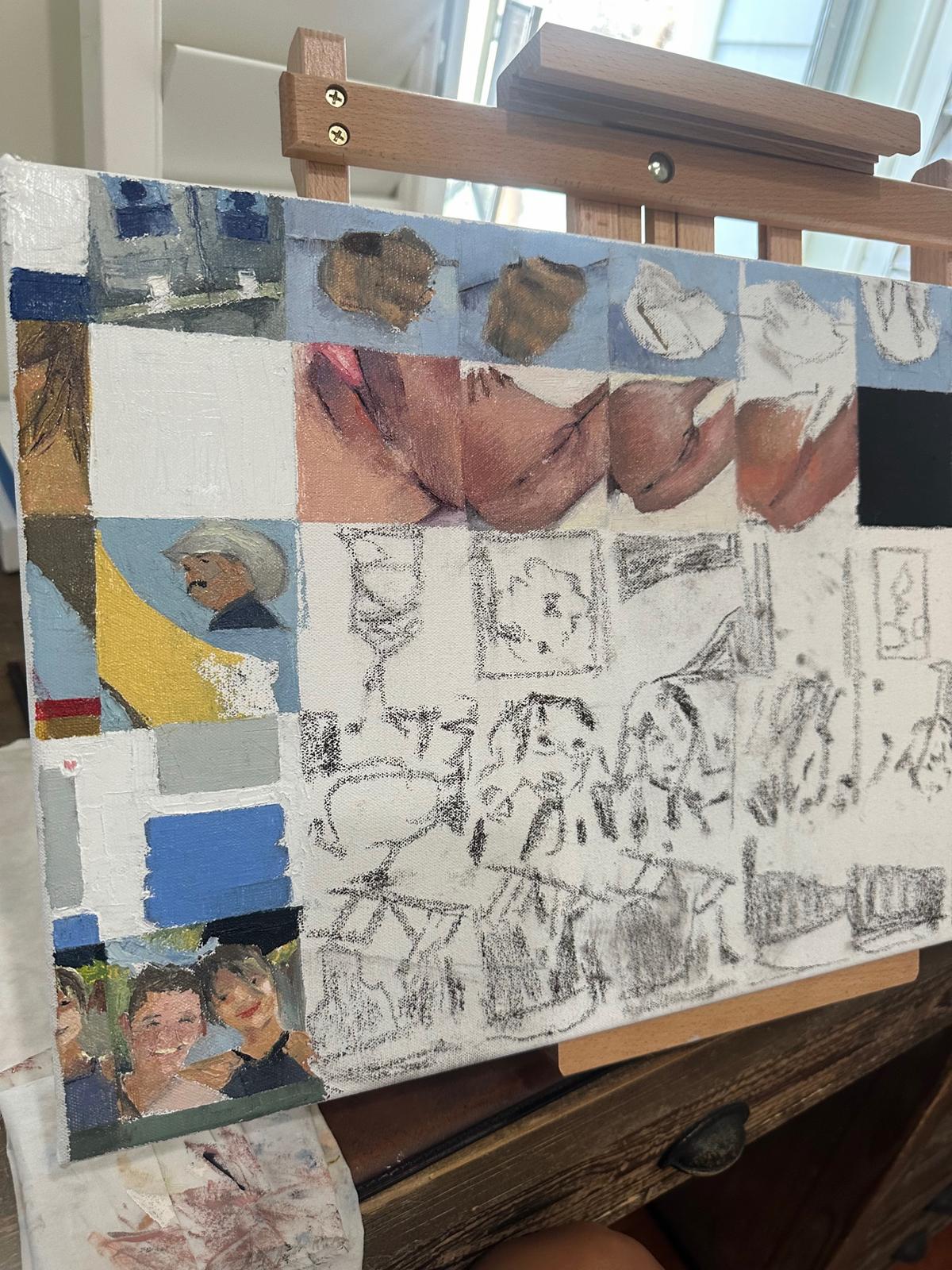 Palette knife work begins. The left side comes alive while the right still holds its pencil bones.
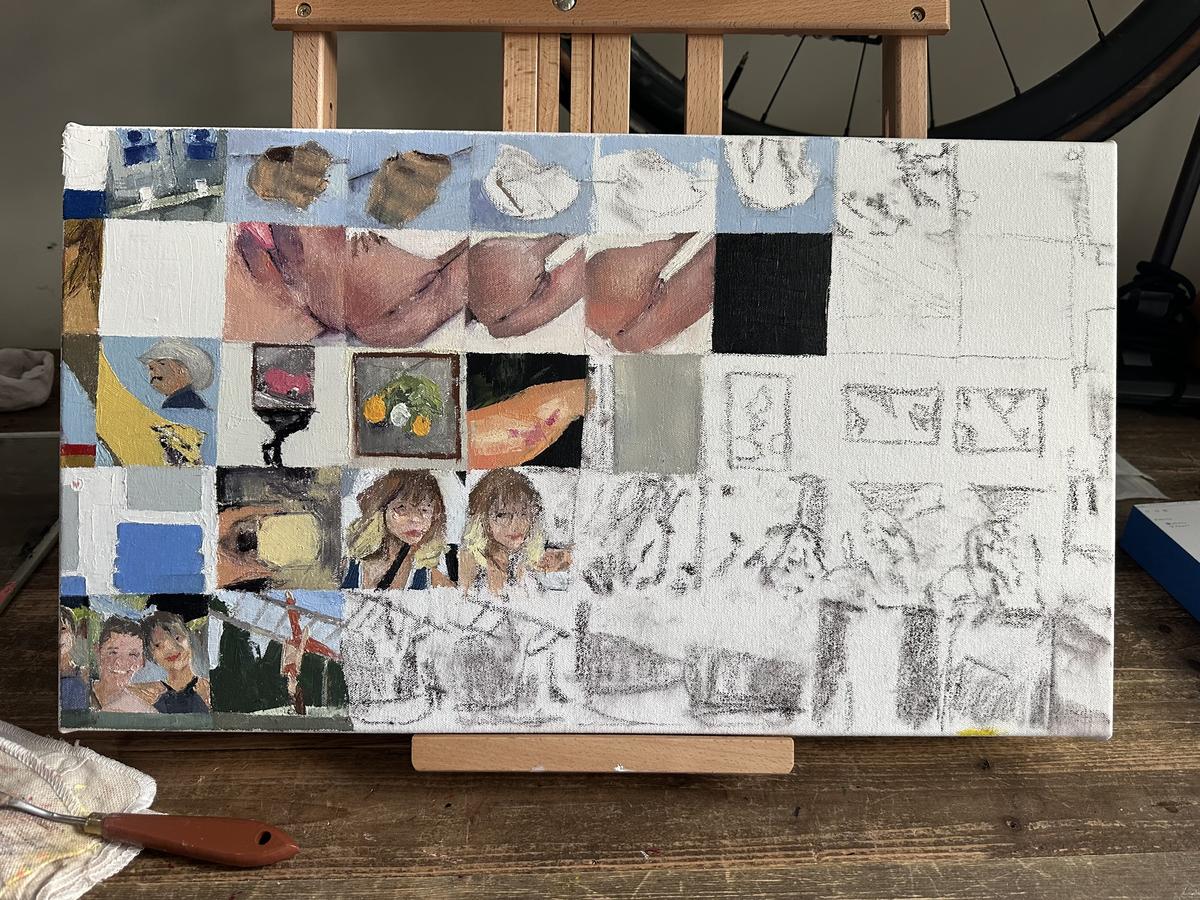 Cam Roll II in progress. The grid fills in, cell by cell, the way a life accumulates.
.
The institutions that respond now will have the privilege of being part of this story from the beginning. The ones that wait will have to explain why they did. I'd suggest, with no particular subtlety, that the latter is the worse position to be in five years from now when the catalogues are being assembled and the early-period works are being identified.
What She Said After
After I told her how rare it was. After I explained that emerging painters don't reach nearly a million people. After I walked her through the comps, the Vienna Tourist Board’s OnlyFans protest, the Venus of Willendorf being algorithmically silenced at thirty thousand years old, the entire absurdist historical pattern of how artists become known and the way the algorithm is reshaping that pattern in real time.
She said: I just wanted to paint my camera roll.
That is the artist talking. That is the answer that makes the work possible. The metrics aren't why she painted it. The reach isn't why she painted it. The recognition, when it comes, isn't why she painted it. The sensitivity screen, infuriating as it is, was never going to change what she painted next. She belongs in that small lineage of painters who simply make the thing because they have to, and let the world decide what to do with it.
She painted Cam Roll II because the camera roll is the most honest archive a person produces, and she wanted to take that honesty seriously, and she wanted to give it the kind of attention that oil painting demands, and she wanted to render her own life without curation, without performance, without asking the algorithm what it found acceptable.
975,900 people saw what she made. 8,048 saved it. The platform tried to suppress it. The work reached them anyway, because people kept sharing it, because the hunger for the real outpaced the appetite for suppression, because something true was finally happening at a scale the algorithm couldn't contain.
She asked if that was a lot.
Yes, Clarisse. It is.
What Happened Next
Within the first week, the inbox changed.
Three galleries reached out about representation. One interview request from a writer who covers the intersection of technology and contemporary art. A handful of collectors asking quiet questions about availability.
And then there were the others; the bewildered ones. People who don't normally reach out to artists, who don't have gallery contacts or collector credentials, who simply saw the painting and couldn't stop thinking about it. They wrote things like: Where can I see more? and Is there a way to follow what happens next? and I showed this to everyone I know.
One offer came in for Cam Roll II itself. We aren't discussing the number. We're discussing what it means that the number exists at all for a painter who, seven days ago, had 3,352 followers and no gallery.
The market moved faster than the institutions. The collectors moved faster than the critics. The audience moved faster than everyone.
This is what happens when the work is undeniable and the hunger is real. The audience found the work. The market followed the audience. The institutions are still catching up.
Let's see what next week bestows upon us.
Clarisse Abelarde is a painter based in Los Angeles. Her work is available at clarisseart.manus.space. Inquiries about Cam Roll II and commissions can be directed there. Follow her at @clarisse.artist.
NUISANCE is her publication.
Tony Greenberg is Founder & CEO of RampRate and Founder of ImpactSoul. He is, as it turns out, in the lower left-hand corner of Cam Roll II.